
The Innovation Mentor

ideas about ideas about ideas about … …

Ideas – Get Rid of Them as Fast as You Can

·

Have you ever found yourself in a business meeting and from nowhere comes an idea which may have some value but is not in keeping with the current conversation? How often have you simply made a mental note to yourself to remember it for later? Did you!?

Making a mental note of an idea is a bad idea for more reasons than just the risk of forgetting it.

Consider these three points:

1. Making mental notes to remember ideas risks them being forgotten.
2. Making mental notes to remember ideas blocks your creativity for new ideas.
3. Making mental notes to remember ideas engenders a ‘scarcity’ mentality.

I am a firm believer in the abundance of ideas and the need to get them out there, get them written down or give them away as fast as possible.

Verbalise

In meetings try and verbalise ideas as fast as possible. Get them out into the open. If an idea is out of context then write is down instead so as to not disrupt the conversation.

Write

There will be times where you simply can’t verbalise your ideas so write them down. Write them the moment they enter your thoughts then put your attention back to the conversation again. At the end of the meeting, tear out the page and offer what you have written.

Abundance vs Scarcity

When you share an idea you create a space for the next to follow. The more you share the more ideas come along and the more chance you give yourself to have those truly breakthrough ideas. When you sit on an idea, brood over it and keep it secret out of fear the effect is the complete opposite. Ideas become scarce and mediocre and creativity withers. This paradigm is every much as true for companies as it is for individuals.

Being sharing and abundant with your ideas must of course be tempered with corporate responsibilities. Legal instruments such as non-disclosure will help here but the more you can share ‘off the cuff’ the more abundant your ideas and creativity will become.

Robert Rath – http://www.innovation-mentor.com
Uncategorized · 2 comments

Do People Play Solitaire At Your Work?

·

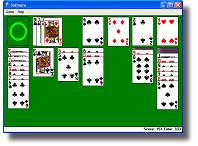
While recently watching someone playing solitaire during their lunch break I found myself wondering if this was a healthy break from the job, a sign of problematic undercurrents or just a mindless addiction.

From these thoughts came a novel idea you might like to consider.

Solitaire as a Management Metric


Could you actually use solitaire playing as a management metric? You could record the number of times solitaire is played during designated breaks and normal work periods, and whether games were played over until a win occurred or the player gave up.

The true value of solitaire as a metric is to not let people know it is being monitored. This ensures it remains a valid indicator of the player and his/her environment. You could then introduce other changes to the workplace and see how solitaire playing behaviour changes.

Of course, using solitaire as a management metric must be done with care and not taken too seriously. But who knows what you might learn! At least it would be fun to try out. If you do, please let me know what you discover.

Robert Rath – http://www.innovation-mentor.com

Uncategorized · 3 comments

Making Wikis Work – Part 1

·

The problem with wikis is that they are only as good as the content created and the use made of that content. Of course this sounds obvious, but it must be understood that a good wiki does not happen by simply putting it into an organisation and seeing what happens.

Here’s the rub… A truly powerful wiki comes from enthusiastic participation of all the users in a wiki community. The diverse nature of that community, however, means that participation by all almost never happens! At best, a handful of contributors populate and manage the wiki content. If you are lucky, the rest of the community uses it. Even if a wiki is seen as a useful forum for information sharing, it will probably fall short of the potential value it can deliver.

A friend of mine who is a talented software engineer used a wonderful little trick to solve the problem in a beautifully simple way. Whenever he was asked to explain something, or to provide help or advice, he would trade that advice for the other person’s participation in creating wiki content. In other words, “I’ll help you if you write it up in the wiki”.

An organisation is full of tacit knowledge which exists in the minds of its people. This know-how has been traditionally shared through asking, through conversation, through mimicry and other forms of on-the-job training – all very inefficient and highly risky to an organisation where key individuals are concerned. By creating a genuine reason to capture this information, by making it valuable enough for someone to put into a wiki, everyone will participate for their own self interest and the greater good of the entire wiki community.

My software engineering friend found a simple way to engage an entire wiki community in his organisation. Before long, their wiki become a treasure trove of tacit know-how and a significant asset to both productivity and to managing the business risk of key people’s knowledge.

Robert Rath – http://www.innovation-mentor.com

Uncategorized · 1 comment

SD Card Trivia

·

My sincere apologies for an article that will add absolutely no value. However, I came across a wonderful little piece of trivia I just could not help but share.

Anyone who has had anything to do with digital media devices, especially digital cameras, would be well acquainted with the ubiquitous SD memory card.

They seem like they have been around forever even though we first saw them in 2000.

Now look carefully at the logo.

Notice that the ‘D’ resembles one half of an optical disk such as a CD-ROM or DVD-ROM. The ‘SD’ logo actually stood for ‘Super Density Disc’, Toshiba’s failed DVD format.

I guess someone could not see the point in employing a graphic designer when they could borrow an old piece of work that already looked the part!

My thanks to Wikipedia for that wonderful piece of enlightenment!

Robert Rath – http://www.innovation-mentor.com

Uncategorized · 1 comment

Ideas are Abundant, Don’t Ignore Them

·

Today I stumbled across Steve Swan’s blog, ‘thinkinghow.com’. His article ‘think fast and get more ideas’ got me thinking about the problem of being ‘idea abundant’.

Problem? I hear you ask!

I know some very creative, inventive people who are simply un-stoppable when it comes to generating ideas. In the workplace they first come across as quirky and novel. It’s fun to have someone always coming up with another cool idea – for a while at least!

We live in a world of ever increasing pressure to do more with less in diminishing time scales. If you are a peer, then that new idea turns into ‘Don’t bug me, I’m busy’. If you are a manager, then that new idea turns into ‘I have enough on my plate already’. Pretty soon that enthusiastic ‘idea abundance’ can take a beating and fade into background noise. To me this is an all too real tragedy of our busy workplaces.

I believe ideas are far more abundant than we realise. Many of us have simply stopped offering them. Others seem more resilient. Ask yourself the following questions.

a) How can we create an environment where ideas are offered without resistance?
b) How can we grow an idea-abundant culture?
c) How can we sort the trivial from the terrific?
d) How can we take action when the right idea comes along?


If you find yourself starting to design a system or process around these questions, then you have just graduated from the very first lesson of creativity and innovation. You need a well structured system or process if you want to consistently have great ideas and turn them into successful outcomes.

A good process will encourage the contribution of ideas and reward the participants without overwhelming already burdened peers and management. In this way, the abundance of ideas will quickly become part of culture rather than the annoying banter of a resilient few!


Robert Rath – http://www.innovation-mentor.com

Uncategorized · 1 comment

Useful User Communications … NOT

·

I am currently involved in a messaging migration project from Lotus Notes to Microsoft Outlook. Part of the process involved creating an installation of Outlook which contains all service packs and hotfixes recommended by Microsoft.

Rather than accept each hotfix in blind faith, I was eager to learn more about each fix. Here is what I found in one instance.

Update for Microsoft Office Outlook 2003 (KB953432)

Brief Description

This update (KB953432) resolves an issue where Microsoft Office Outlook 2003 behaves unexpectedly in some circumstances.


Now either this was a case of ‘too hard to explain’, or someone just got lazy. In any case it left me decidedly uncomfortable with the lack of communication.

Would you blindly accept this level of communication from someone you did not trust? Do we really trust Microsoft?! I don’t think we do, yet we now religiously accept updates and hotfixes with almost paranoid fear that if we don’t, our PC will turn into virus-ridden email spamming bots. Sure there are some real threats out there we need to protect ourselves from, but not at the risk of all being lemmings headed for some looming precipice.

So please Microsoft, I’m happy to use your hotfix but I want to know why and be confident I really need it. I need your communications to be useful.

Of course I included it, I’m sure it’s needed, how could I not! I trust them because they are Microsoft. 😉

Robert Rath – http://www.innovation-mentor.com

Uncategorized · 1 comment
